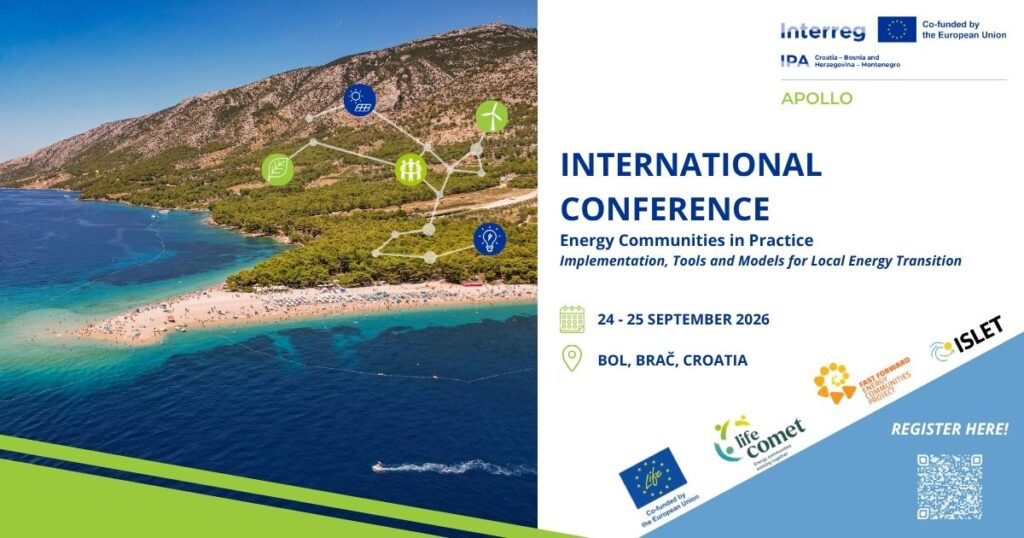
Only a few days remain until the conference that takes place on 24 and 25 September, at the Bluesun Hotel Elaphusa in Bol on the island of Brač. Registration is still open for anyone interested in citizen energy.
This international conference aims to connect practical experience with the relevant institutions and open a discussion on concrete steps which can accelerate the development of energy communities. The conference brings together energy communities from Croatia, the region and across Europe, as well as institutions responsible for setting and implementing the rules governing citizen energy. Here is what the organisers have to say ahead of the event.
Turning Citizens’ Rights into Real Energy Communities
Goran Čačić from the Green Energy Cooperative ZEZ, who will present experiences from the LIFE COMET and DBU/ECF Fast Forward Energy Communities projects, points out that the EU’s “Clean Energy for All Europeans” package and European directives “give us, as citizens, the right to produce, consume, store and sell our own renewable energy and to join together in renewable energy communities.” He emphasises that Croatia already has the knowledge, interest and several promising initiatives, but that the conditions must now be created to make it easier for these initiatives to move from ideas to actual implementation.
Those Who Have Already Encountered the Barriers Know Them Best
Speaking from the perspective of those who have already encountered such barriers is Ivan Zoković from the Apsyrtides Energy Cooperative, an island cooperative bringing together citizens, experts and island institutions. He will take part in a panel on cities, municipalities and counties as drivers of energy communities. “Energy communities in Croatia are no longer just an idea, because there are citizens, cooperatives, cities and municipalities ready to develop concrete projects. Institutions now have a key role to play in creating simple, clear and workable conditions that will allow energy communities to become a reality.”
One Model Will Not Fit Everyone
Kristina Mudronja from the ZADRA NOVA development agency, an adviser on the APOLLO project, which connects experiences from Croatia, Bosnia and Herzegovina, and Montenegro, emphasizes that “the key is to connect knowledge, local needs and existing initiatives so that energy communities can more easily become a reality. One model will not suit every community, and energy communities need to be developed in line with the needs, resources and opportunities of the area in which they operate – whether it is an island, a city, a rural area or a group of public institutions.”
The Second Day of the Conference Will Focus on Practical Work and Concrete Local Situations
Members of the Croatian Energy Communities Forum will present their models, with the aim of giving participants not only a better understanding of the topic but also a concrete picture of where to start, whom to involve and how to adapt a model to their own local context. Participants will hear how different initiatives brought together, secured initial funding, launched their first project, and addressed legal, technical and organizational barriers.
A range of different models will be presented: from citizen investment in a jointly owned power plant and an energy community involving eight cities and municipalities, to an island energy cooperative, one of Croatia’s first registered citizen energy communities, and a small local project developed around the rooftop of a public building.
These will be followed by examples from Slovenia, Greece, Bosnia and Herzegovina, and Montenegro developed through the LIFE COMET and APOLLO projects: Solar School Hrastnik, the Greek Desmi coalition, public investments by the City of Mostar, and the coastal model of the Municipality of Tivat.
The second day will conclude with a practical lab in which participants will work in groups to define concrete pathways for the development of energy communities. The conclusions will be consolidated into the “Brač Conclusions”.
How to Register for the Conference
Registration for the conference is still open. Participation is free of charge, with mandatory registration via the ONLINE REGISTRATION FORM.
The updated programme and list of confirmed speakers are available on the organisers’ website. The conference is intended for citizens, energy communities and cooperatives, cities, municipalities, counties, development organisations, and everyone involved in the development of local energy projects.
The conference is organised by the Ministry of Regional Development and EU Funds, the ZADRA NOVA Development Agency of Zadar County, the Green Energy Cooperative ZEZ, and the Island Movement, within the framework of the APOLLO, LIFE ISLET, LIFE COMET and DBU/ECF Fast Forward Energy Communities projects.
LIFE ISLET – Innovative Supporting Schemes for Community-Led Energy Transition
The LIFE ISLET project is co-funded by the European Union through the LIFE Programme under Grant Agreement No. 101120073.
LIFE COMET – Coalitions for Catalysing Citizen Energy in Eastern EU
The LIFE COMET project is funded by the European Union through the LIFE Programme under Grant Agreement No. 101120519. The project is co-funded by the Office for Cooperation with NGOs of the Government of the Republic of Croatia.
APOLLO – APplication Of upscaLed interregionaL renewable & energy efficiency sOlutions
The APOLLO project is co-funded by the European Union under the Interreg VI-A IPA Croatia – Bosnia and Herzegovina – Montenegro Programme 2021–2027.
DBU/ECF Fast Forward Energy Communities
The project is co-funded by the German Federal Environmental Foundation (DBU) and the European Climate Foundation (ECF). The project is implemented by the partners: the Institute for Political Ecology, Green Energy Cooperative, Terra Hub and Friedrich Ebert Stiftung Zagreb.
The views and opinions expressed are solely those of the author(s) and do not necessarily reflect those of the European Union or the European Climate, Infrastructure and Environment Executive Agency (CINEA). Neither the European Union nor the granting authority can be held responsible for them.