Did you know that, according to the goals of the European Solar Energy Strategy, Croatia should already have at least 80 renewable energy communities — one in every town with more than 10,000 inhabitants? And do you know how many we currently have? One, and it is still in the process of registration.
We also have three registered citizen energy communities, five years after the transposition of the EU directive that gives us the right to produce energy for our own needs and, as citizens — individually or through energy communities — actively participate in the energy transition. This shows that, in Croatia, the citizen energy model is still struggling to take root in practice.
To better understand why this is the case and what citizens actually think about the energy transition, in January 2026 we conducted the first survey on citizen energy in Croatia. The survey was carried out on a sample of 800 Croatian citizens, representative by gender, age and region.
Citizens expect energy communities to be part of the future
More than half of Croatian citizens expect that, in 20 years’ time, as much as one quarter of electricity will be produced through energy communities, while one in five expects even more than that. Citizens, therefore, do not see energy communities as an experiment, but as an integral part of the future energy system.
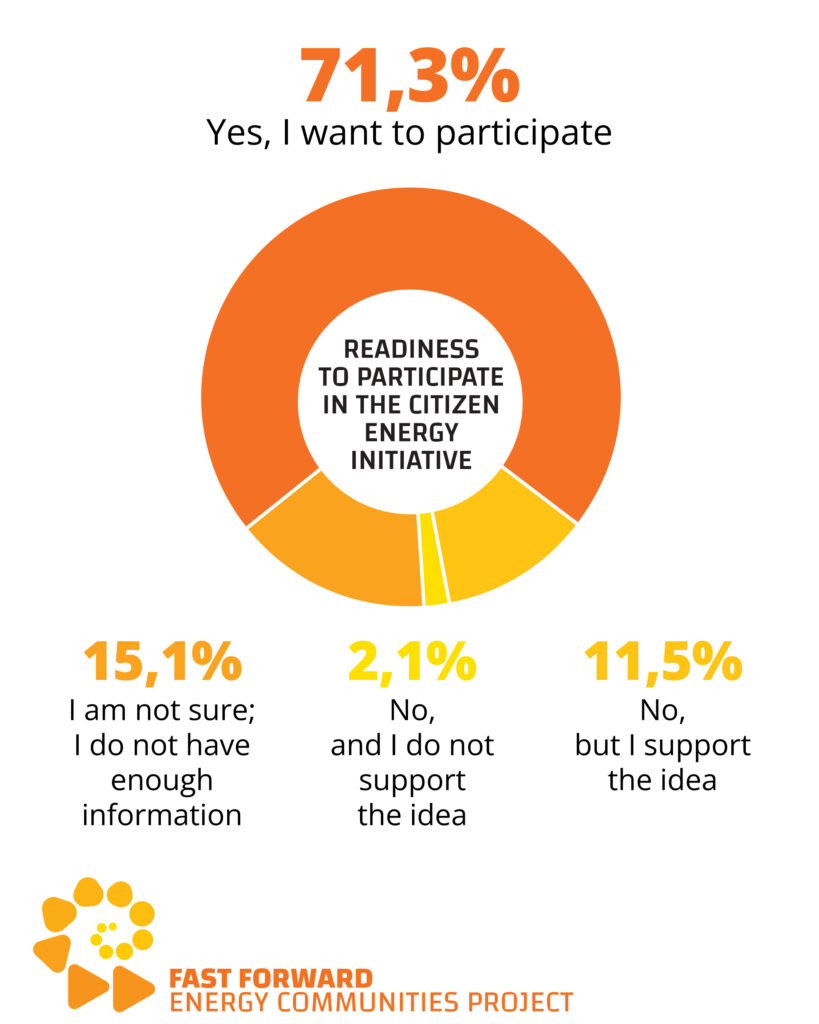
71% of citizens want to produce energy together with their neighbours
Almost three quarters of citizens are willing to participate in joint energy production, for example through a shared solar power plant on a rooftop. But under clear conditions:
- the model must be simple
- it must be defined by a clear contract
- it must not require the establishment of a legal entity
- it must be economically viable
Citizens want to take part, but they do not want a bureaucratic maze.
Key motivation: savings and energy independence
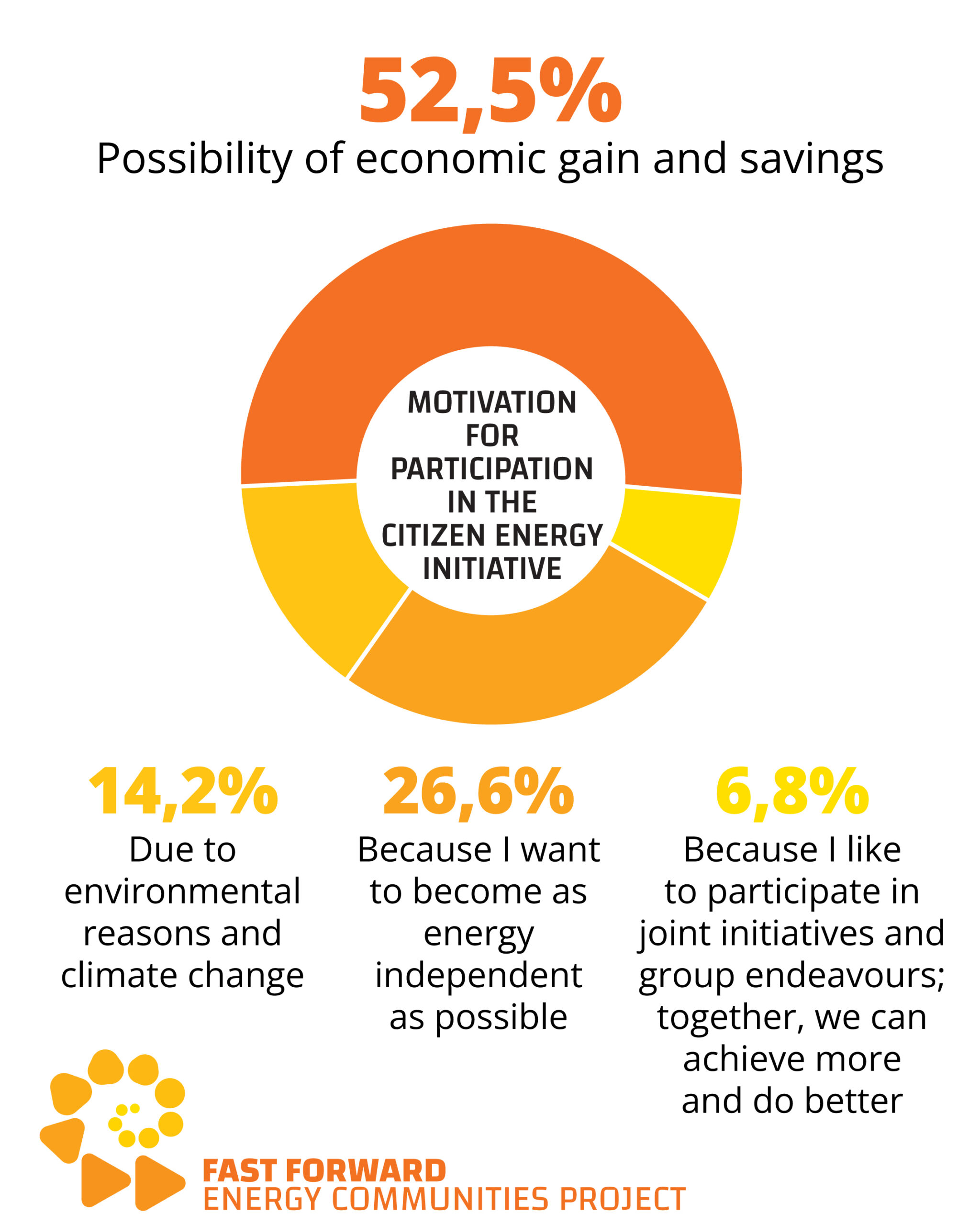
A large majority of citizens are willing to invest and become part of a community that builds renewable power plants, in return for a share of the revenue from selling energy or direct savings on their electricity bills. Their primary motivation is potential economic benefit, savings and energy independence.
For most citizens, citizen energy is not an ideological issue — it is a rational decision.
- 60% of citizens are willing to invest
- 53% are motivated by economic benefit and savings
- 27% are motivated by energy independence
Citizens want lower bills, greater control over their energy and a safer future.
Citizens expect support from the state, and do not believe anything will happen without it
Citizens clearly recognise the role of the public sector in the development of energy communities:
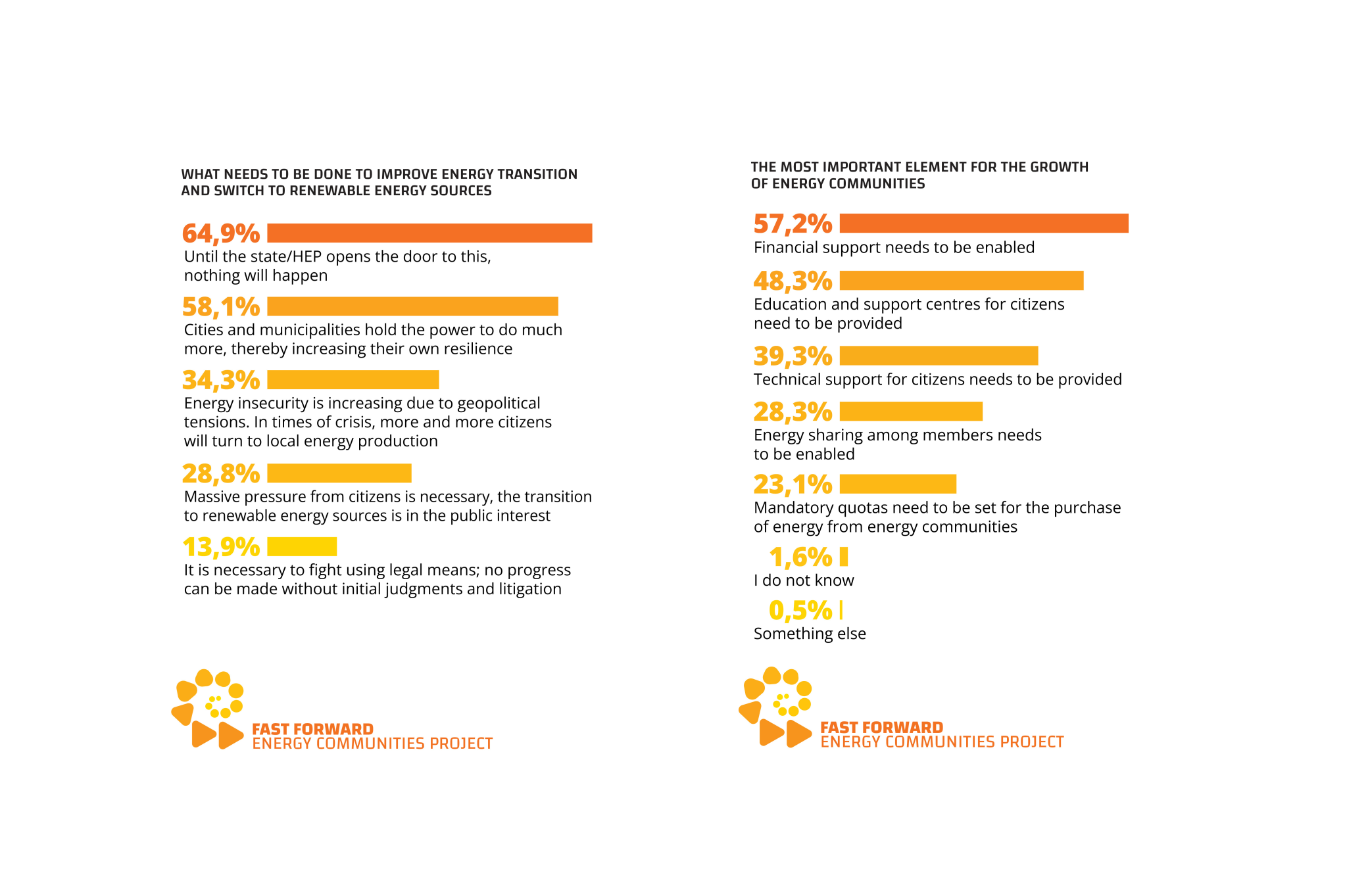
- 60% expect financial support
- 48% expect education and support centres
- 40% expect technical support
At the same time:
- 65% believe that nothing will move forward without the state’s “green light”
- 58% expect greater involvement from cities and municipalities
- 42% see the reluctance and lack of understanding of institutions as the biggest obstacle
The message is clear: the problem is not the citizens — it is the system.
The broader context: citizens want climate action
The results also fit into the broader picture shown by the 2025 EU Barometer survey on climate change:
- 85% of Croatian citizens consider climate change a serious problem
- 94% believe that governments should invest more in renewable energy sources
- 90% support the goal of climate neutrality by 2050
At the same time:
- 62% believe that the media do not provide clear information
- 52% find it difficult to distinguish reliable information on social media
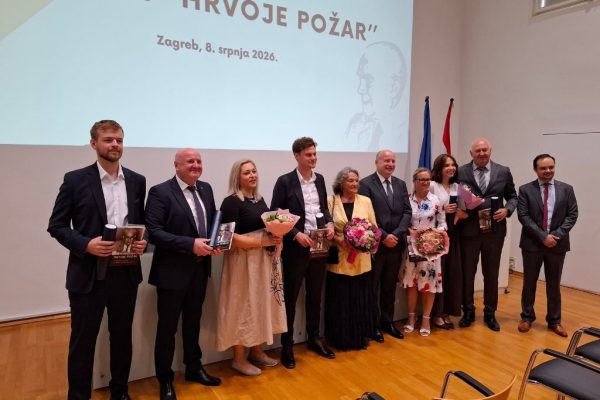
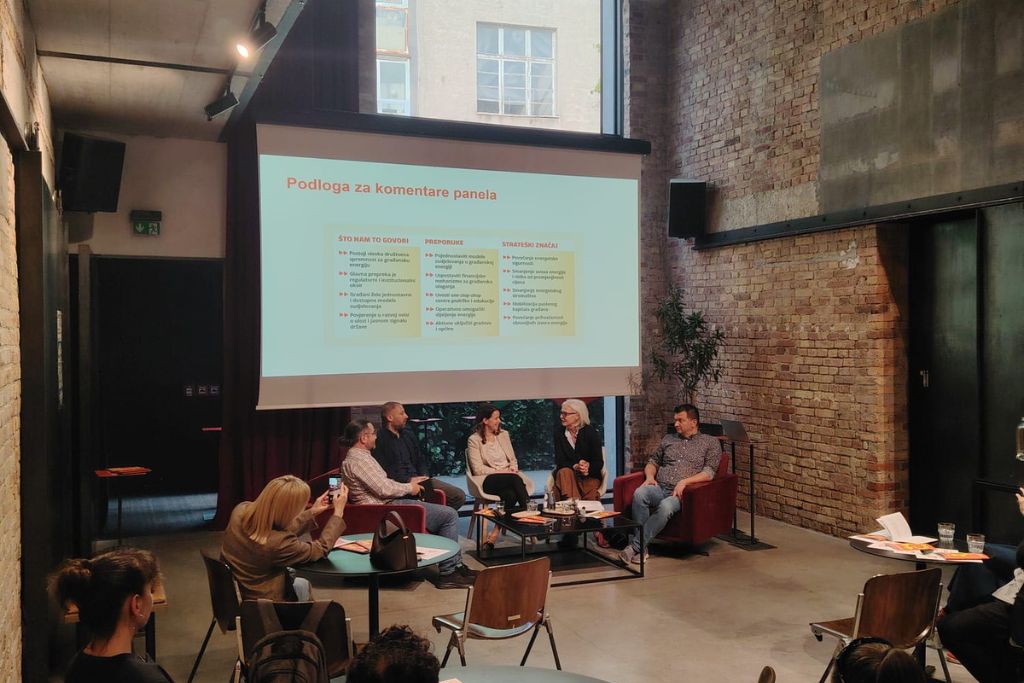
There is a high level of awareness, but a lack of clear and accessible support, reliable information and education at all levels. This was also highlighted during the panel discussion that reflected on the key findings of the survey, presented on 27 April in Zagreb.
The panel included:
Dušica Radojčić, Member of Parliament and Chair of the Committee on Environmental Protection and Nature Conservation
Dr. Goran Krajačić, Full Professor at the Faculty of Mechanical Engineering and Naval Architecture, University of Zagreb
Marija Hanzec, Head of Communications and Market Analysis at the Renewable Energy Sources of Croatia association
Enes Ćerimagić, programme lead for public and common goods, lawyer and Vice-President of Zelena akcija
The discussion was moderated by Goran Čačić, expert in sustainable energy and citizen energy at the Green Energy Cooperative, and coordinator of the Energy Communities Forum in Croatia, which brings together 22 citizen energy initiatives.
The panellists discussed which survey results they considered most important, what kind of energy communities they themselves would be willing to join, and what is needed — legislatively, institutionally and in terms of structured support — to significantly accelerate citizen energy projects in Croatia.
Alongside the need to remove administrative barriers, the panellists agreed that there must be more trust — both among citizens and towards institutions — as well as much more knowledge and visibility of the topic of citizen energy, not only among the general public, but also at the political level and in the media.
All details of the survey and insights from discussions with representatives of citizen energy initiatives are available in our new publication: Together at Full Power – Contributions to the Analysis of the Potential for the Development of Energy Communities in the Republic of Croatia.
Croatia does not have a problem with interest — it has a problem with implementation
Energy communities are not only a tool for reducing emissions. They are:
- a tool for energy security
- an opportunity for local economic development
- a way to strengthen community resilience
- a step towards a more democratic energy system
In Croatia, they are currently standing still. Not because citizens do not want to participate, but because the institutional framework still does not reflect their needs and readiness. It is time for the system to catch up and provide adequate support.
Ahead of us is the new Multiannual Financial Framework of the European Union for the period 2028–2034, which introduces a new instrument — the National and Regional Partnership Plan (NRPP).
This is a key mechanism through which the development of Member States will be financed. It accounts for as much as 44% of the total EU budget, with the total value of the plans amounting to EUR 865 billion.
Through the NRPPs, Member States will define reforms and investments in key sectors, including energy, cohesion and agriculture. This is precisely why this is an important opportunity to systematically include energy communities in financial and development plans, and to enable Croatian citizens to actively participate in the energy transition — because they want to.
The survey was conducted by the agency KARIKA koja nedostaje d.o.o. for the commissioning partners of the project Accelerating Energy Communities in Croatia, co-financed by the German Federal Environmental Foundation (DBU) and the European Climate Foundation (ECF).